

Introduction
Introduction
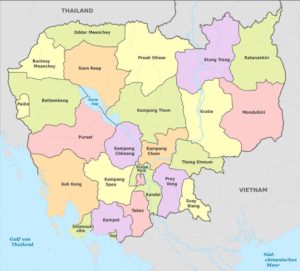
The Kingdom of Cambodia, formerly Kampuchea, is a Southeast Asian nation that borders Thailand, Laos, Vietnam, and the Gulf of Thailand. The capital city is Phnom Penh.
Location
Cambodia is located in Southeast Asia in-between Thailand and Vietnam with Laos to the North.
Its serene coastline borders the Gulf of Thailand. Cambodia is a tropical country and its southernmost point is a mere 10 above the equator. It covers 181,035 square kilometers.
There are mountains to the North and East but the land is mostly flat; perfect for rice cultivation. Indeed, Cambodia Jasmin Rice recently neon the world’s Best Rice competition three times in the row. The green rice fields and trees are fed by the giant Tonle Sap Lake and famous Mekong River-the 12th longest river in the world–that flows through the country and the capital city, Phnom Penh.
Minerals, oil and natural gas deposits were recently found beneath Cambodia’s territorial waters- valuable assets that will surely contribute to this burgeoning economy.
Climate
Cambodia’s climate is hot and sunny all year round. Like most Southeast Asian countries there are two season-the rainy seasons and the dry season. The rains fall May-October and it is dry during November-April. December and January are the coolest months and April are the hottest. The average temperature is 27-280 C. During the rainy season downpours are limited to a couple of hours a day in the late afternoon or overnight so many tourists still come during this time to enjoy the country.
Population
Cambodia’s total population is roughly 15.95 million people, 90% of whom belong to the Khmer ethnic group. Many foreigners live here too and some ethnic groups have made their home in Cambodia for centuries including the Chams ( Muslim Khmer ), Chinese, Indian, Vietnamese, Thai, Kuoy, Stieng and Tamil. Chinese people have a strong influence, particularly in the business sector. Khmer is the official language of Cambodia.
Religion
Theravada Buddhism is the oldest surviving from the religion and is practiced by 90% of the Cambodia population. Cambodian Buddhism shares much with other Theravada countries but has many notable and unique qualities. Buddha statues are revered in Cambodia and visitors are kindly asked to respect the customs surrounding these items ( such as not pointing your feet towards a Buddha statue and dressing respectfully in the temple ). Islam, Christianity, and Hinduism exist harmoniously alongside the main religion.
Language
Khmer is the official language of Cambodia. It is one of the oldest Language in the region and is derived from the Mon-Khmer (Austro-Asiatic ) language family. It is notable for its extensive alphabet with 33 consonants, 23 vowels, and 12 independent vowels. Unlike other Asian languages, Khmer is not tonal and so is quite approachable for foreigners. While learning simple phrases is approachable for foreigners. While learning simple phrases is appreciated, English, French, and Mandarin are widely spoken.
National Flag
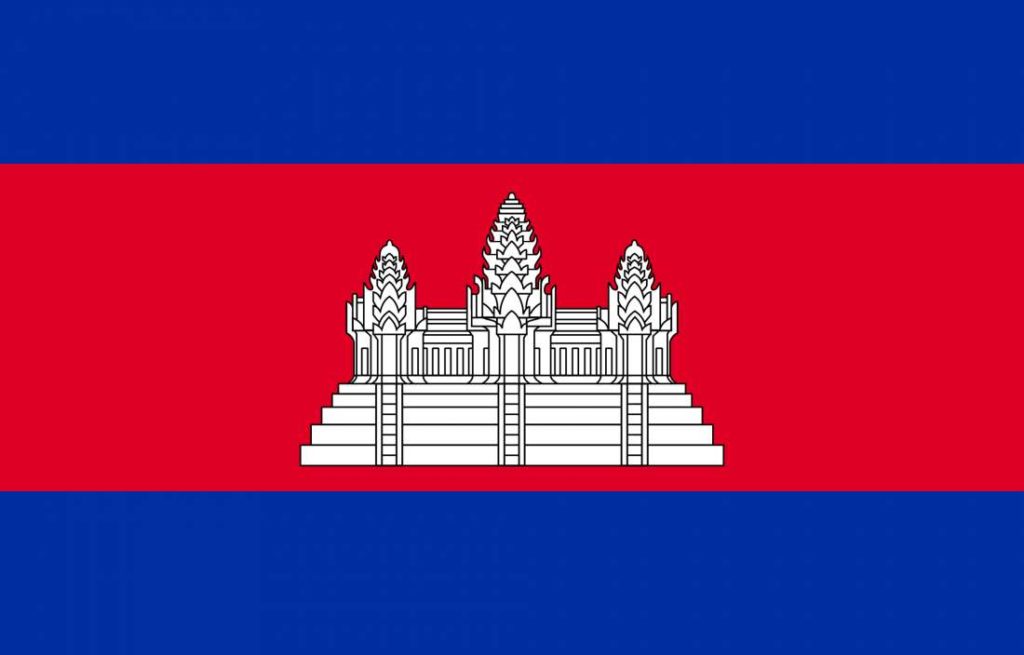
The Cambodian national flag was adopted in its current in 1948 when Cambodia broke with French protectorate. It was readopted in 1993 following the end of the civil war. The Angkor Wat temple represents the Buddhist religion of the country along with the dignity and heritage of the Khmer people. The blue stripes represent the king and also stand for liberty and co-operation. The red represents the people and also stands for bravery. In short, the flag sums up the slogan: “nation, religion, king.”
National Flower
Romdul(Sphaerocoryne affinis) is the national flower of Cambodia. It is a small, pale yellow flower with a heady fragrance that can travel far and wide in the wind. Cambodia women have often been compated to the Ramduol flower and such is the regard for this pretty thing that several regions have been named after it. The Romduol plant can grow to a height of 12 meters and many have been planted in Cambodia’s public parks.

Money exchange
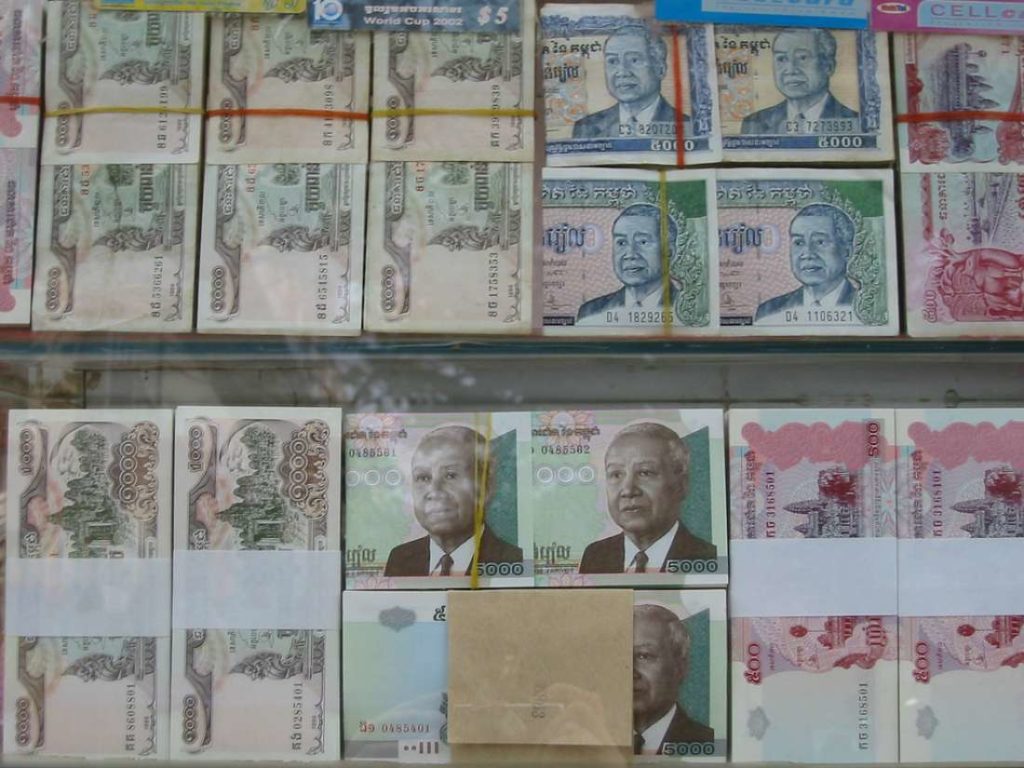
Cambodia Riel(KHR) is the official currency. However, the US dollars are in common use. Most businesses in the country, especially hotels, restaurants, airlines, markets, and shops actually set their prices in US dollars. Change of less than one dollar is given in riel. Do inspect the bills when accepting money. Marred riel is acceptable tender, but the tiniest tear in a large US note renders it unusable in Cambodia.
Electricity
- Voltage: 230 V
- Frequency: 50 Hz
- Picture- Power sockets
The standard voltage in Cambodia is 230 V and the standard frequency is 50 Hz.
Purchasing a phone number/SIM card
You can purchase a SIM card and telephone number outside the arrival terminal at the Phnom Penh International Airport or from any of the many phone shops scattered across town. Valid passport and visa are required.
Banks and ATMs
Banks in Cambodia provide currency and travelers check exchange, credit card advance, telegraphic transfers, and all regular banking service. Most banks are open from8:00 to 3:00 or 4:00 pm for some; Mondays through Fridays. Some are open Saturday morning until 11:30 AM
ATMs, located all across town, are active 24/7 and accept Visa and MasterCard. The machines dispense one’s preference.
At the time of printing, the average rate of exchange is 4,000riel to 1USD.
Credit Cards
Visa, MasterCard cards are the most widely accepted credit cards in Cambodia. AMX is accepted at a few places while Diners club or eat fewer places. Many businesses charge a fee on credit card payment.
Travelers checks
Travelers checks are accepted at most banks, major hotels, and some money changers.
Cash Transfers
‘Instant’ cash transfers can be done through Western Union or MoneyGram. ordinary telegraphic transfers are available at all major banks.
Visa on Arrival
Visa on Arrival can be obtained at the Visa Counter upon arrival at the Phnom Penh International Airports. However, please note that not all foreign passport holders can apply for a visa on arrival. It is therefore important to check with the nearest Royal Embassy of Cambodia for the specific visa requirements for the countries in question.
Transportation
The country possesses twenty-six airfields, of which only thirteen were usable in the mid-1980s. Eight airfields had permanent-surface runways. Phnom Penh International Airport in Phnom Penh is the largest airport; it also serves as the main base for the renascent Cambodian Air Force. Cambodia’s second largest airport is Angkor International Airport in the major tourist city of Siem Reap. Tourist traffic into Angkor International Airport saw passenger numbers overtake those of Phnom Penh in 2006, the airport now being the country’s busiest. Cambodia also opened a new Soviet-built airfield at Ream, Sihanoukville International Airport in late 1983, which never saw commercial air traffic until now. There are additional airports in Battambang and Stung Treng. The new national airline Cambodia Angkor Air was launched in 2009, with a large financial investment from Vietnam Airlines. And Aero Cambodia Airline started the business in 2011 offering flights to all airports and waterways with seaplanes.


Social :